

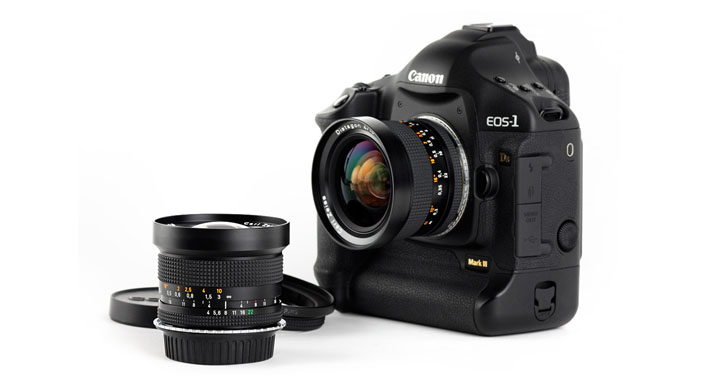
CONTAX T* 18MM F4 DISTAGON LENS OVERVIEW
Updated November 25, 2014

|

|

|

|

|

|

|

|

|

|

|

|

|

|
| First Year Available | 1975 (AE Mount) |
| Lens Composition | 10 Elements / 9 Groups |
| Floating Lens Group | Yes |
| Angular Field of View | 100º |
| Minimum Focus | .3 Meter / 1 Foot |
| F-Stop Scale | F4 to F22 in 1 Stop Increments |
| Aperture | Automatic on Contax RTS, fully manual otherwise |
| Filter Size | 86mm |
| Lens Cap | 70mm Slip on Type, Hard Rubber |
| Lens Hood | 70/86 Ring + Metal Hood No. 1 (may vignette) |
| Hood Cap | K-94 99mm Metal Cap Hood Cap |
| Rubber Hood | None |
| Lens Pouch | No. 2 |
| Lens Size | 70mm x 51.5mm / 2.75 in. x 2.00 in. |
| Weight | 350 Grams / 12.3 Ounces |
OVERVIEW
I am a sucker for a nicely made lens and the Contax 18mm Distagon easily falls into that category. The build is excellent. The lens feels solid and very well constructed. In terms of build quality and feel, the Contax 18mm is my favorite Contax lens. The 18mm Distagon is a compact lens and only about 1/3 the size of a Canon 16-35L F2.8 II. As a travel lens the Contax 18mm is light, small and easily fits into a camera bag.
BUILD QUALITY
The Contax 18mm Distagon’s manual focus ring is sublime and probably the smoothest focusing Contax lens. The focus ring only requires a light touch - very Leica-esque. Like all the Contax RTS lenses, the aperture ring clicks in full stop increments. The 18mm Distagon uses the Contax 70-86 Metal Ring as a combination hood / filter adapter. The Contax specifications state to use the Contax #1 Metal Hood, but in my opinion the 70-86 ring did well enough.
The Contax 70/86 rings are difficult to find and sell for $75 to $150. The Contax 70-86 ring is not a must have, but it is handy. The front portion of the 18mm Distagon’s barrel rotates as the lens is focused. The Contax 70-86 adapter ring attaches to barrel (held in place by pressure), thus the attached filter will also rotate. In the case of a polarizer or graduated filter this can be irksome.
The 18mm Distagon comes with a 70mm push-on rubber cap for the front element. These caps are also difficult to find. A 70mm Kaiser push-on cap (available here at B&H Photo) works as a replacement, but for $9 do not expect much. The original Contax cap is a thick, hard rubber-like plastic that provides impact protection. The Kaiser cap is a thin plastic which flexes easily. It covers the front element, but provides minimal protection. Again, for $9 it is fine.
LENS PERFORMANCE
Zeiss advertised the Contax 18mm as a compact design with sharp corner performance and excellent distortion correction. Part of the performance is attributed to the floating lens element design. A floating element design improves near field performance - both in terms of sharpness and resolution. From a creative standpoint, I like to focus on near subjects, so the Contax 18mm floating element is an important consideration (for my needs).
If shooting F4 or F5.6, the Contax 18mm will produce a classic rendering with moderate light fall off in the edges and corners. Some people may like the light fall off, so it comes down to taste and preference. I like light fall off and tend to add some during post processing, so the 18mm Distagon’s inherent light fall off is a non-issue for me. But, I do keep a watchful eye on metering and exposure compensation when shooting at wider apertures. And at F8 and F11 the light fall off is a non-issue.
The 18mm Distagon colors are pure Zeiss with the strong sky blues and vibrant contrast. I do not use a polarizer on the 18mm Distagon because polarizers tend to effect half the frame but not the other half (as much) with focal lengths wider than 24mm. Also, the Contax 70-86 adapter ring rotates as the lens is focused, so using a polarizer is frustrating at best. Lastly, compared to the 21mm F2.8 Distagon and the 28mm F2.8 Distagon, the 18mm Distagon has less visible distortion to my eye. Chromatic aberrations are well controlled as well.
LENS ADAPTERS AND MIRROR CLEARANCE
Reports concerning the Canon 5D & 5D Mark II and 18mm F4 Distagon have been mixed, with some owners experiencing clearance issues with the rear element and mirror. The most likely cause is the 18mm Distagon’s rear glass protruding too far into the Canon 5D’s mirror box (regardless of adapter thickness).
The AE version appears more likely to work than MM version because the older AE version has a different type of retaining ring on the rear element. The AE’s retaining ring is angled, thus allowing more room for the mirror to clear as it swings past the rear element. Whereas the MM version has a low profile ring and the rear element actually sticks out past the ring (the element is convex).
For the Canon 1Ds series bodies (Mark I, II and III) and the Canon 1.6x sensor-sized bodies, there have not been any clearance issues. And for today's modern mirrorless cameras, mirror clearance is a complete non-issue.
CONCLUSION
18mm is a dramatic focal length. Shooting with the lens pointed slightly towards the sky produces a feel of the clouds racing across the sky and spreading out across a vast area. I like to shoot from a low perspective with the lens angled upwards.
I have tried focusing on subjects 2 feet away and results have been mixed because “seeing” focus is difficult with such a wide lens. Plus, physically being in position to compose and focus from a low position is difficult - and dirty if laying on the ground in the mud! Live view and flip screens helps immensely.
Optically, the 18mm Distagon is a good wide angle prime. The corners are better than those from Canon 16-35L II. The 18mm Distagon's wide open performance (F4) can be soft and the lens seems happiest when the subject is 5 feet or further away.
I like the 18mm Distagon, but the lens certainly has its nay-sayers - mostly due to the light fall off in the corners. If seeking a lens with best in class technical attributes, the 18mm Distagon probably is not the right choice. If looking for an 18mm lens with its own personality and good optical performance, then 18mm Distagon is definitely a candidate.
I love the 18mm’s build quality and enjoy using the lens. Its compact size makes it is easy to carry and takes up little bag-space, unlike the Zeiss 21mm Distagon. If worried about mirror clearance, the Zeiss 18mm F3.5 Distagon ZE is a great modern alternative on dSLRs, though it is not as compact as the original Contax.


