

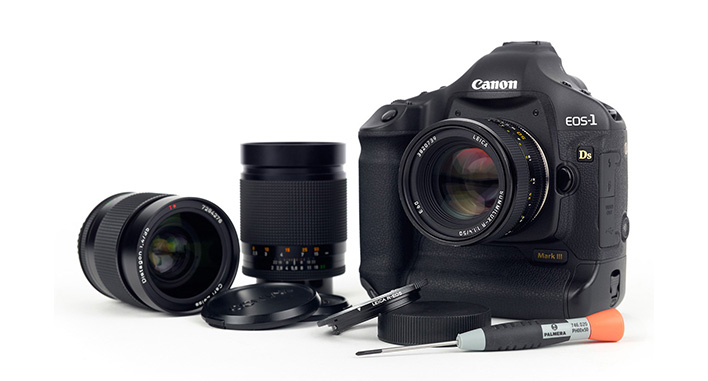
CONTAX C/Y LENSES THAT FIT CANON DSLR’S
ARCHIVED January 1, 2011
THE FF, 5D, 1.3x AND 1.6x COLUMN HEADINGS
The Contax C/Y / Canon database is a quick reference to see which Contax RTS lenses can be mounted on Canon EF-mount dSLRs via adapter. Most lenses work without issue; however, some have mirror clearance issues. Scrolling to the right provides more information about the lenses.
- FF refers to Canon’s professional full-frame dSLRs such as the Canon Mark III and 1Dx.
- 5D refers to the Canon 5D, Mark II, Mark III and Canon 6D.
- 1.3x refers to the Canon APS-H bodies such as the Canon 1D Mark III and 1D Mark VI.
- 1.6x refers to the APS-C bodies such as the Digital Rebels and Canon 7D.
WHAT DO “M”, “S” AND “I” MEAN?
- Y means “YES”. The Contax lens will work and most people have not experienced issues.
- N means “NO”. Generally, the combo is a no-go without physical mods to the camera or lens.
- I means “Iffy”. Conflicting reports of "yes" and "no".
- ? means no data available.
- Dashes (“-”) mean the data is unavailable.
Canon 5D and 5D Mark II owners have reported various mirror clearance issues. Complicating matters, there are variances amongst Canon 5D’s. Thus, the Canon 5D earned its own column. Whereas Canon EF-s cameras have smaller mirrors, so just about any lens will work them. The Canon 1-Series (1D, 1D II, etc.) usually work out fine. According to marketing literature the Canon 1D Mark III sports a larger viewfinder. User feedback indicates it is best to consider the 1D Mark III as having the same clearance as a 1Ds and 1Ds Mark II.
THE DATABASE SHOWS “YES”, BUT I KNOW THE LENS DOESN’T FIT!!!
Deciding whether a lens deserves a “YES” is tricky due to conflicting user reports. The likely culprit is not the lens or camera, but the adapter. To reflect these conflicting reports the “I” category was added, meaning “iffy”. The sections below provide additional commentary for the more troublesome lenses.
- Canon 5D dSLR and Canon 5D Mark II
The following applies to just about every Contax C/Y lens 50mm and wider
It is common to read about one Canon user enjoying success with a given lens and adapter, and another person saying it does not work. There is speculation about Canon’s quality control and placement of the mirror box. Photographers with multiple Canon 5D’s have cited occurrences where a Contax lens and adapter works fine with one of their 5D’s, but not the other. Finding the right adapter thickness is often the key.
- Contax 15mm F3.5 Distagon
The following applies to the Canon 5D and 5D Mark II
User reports indicate mirror clearance on the Canon 5D Mark II is a potential problem. Some people are using the lens via Live View, but it is a serious kludge because of the mirror clearance issues.
- Contax 18mm F4 Distagon
The following applies to the Canon 5D and 5D Mark II
In some cases a rear retaining ring holding the rear element in place catches the Canon 5D mirror. A thicker adapter resolves problem, but at the risk of losing infinity focus. The problem has been reported with both AE and MM versions. The lens is reported to work fine with the Canon 1-Series bodies and the 1.6x EF-s bodies.
- Contax 21mm F2.8 Distagon
The following applies to the Canon 5D and 5D Mark II and possibly others
The generally accepted correct “technical” adapter flange thickness is 1.5mm. In practice 1.425mm has proven to be the best all around adapter thickness. Some have reported 1.2 to 1.3mm being better for the 21mm Distagon. Such a thin adapter could have clearance issues on a Canon 5D - and possibly even the 1-series. Overall, using the 21mm Distagon on a Canon 1.6x or Canon 1-Series will work fine. 5D owners may need to experiment with various adapter thicknesses.
- Contax 28mm F2.0 Distagon
The following applies to the Canon 5D and 5D Mark II
In some cases a rear retaining ring holding the rear element in place will catch on the 5D’s mirror. A thicker adapter may resolve the problem, but may also compromise infinity focus and could diminish the lens' overall performance given its floating element design. The problem has been reported with both AE and MM versions. The lens is reported to work fine with the 1.6x dSLRs such as 40D and 1-Series bodies.
- Contax 28mm F2.8 Distagon
The following applies to the Canon 5D and 5D Mark II
The 28mm F2.8 Distagon has a reputation for not fitting Canon 5D’s. It is the same old story - adapter thickness. The standard procedure is to buy multiple adapters and hope for a magic combination, and/or to try multiple versions of the lens itself.
- Contax 35mm F1.4 Distagon
The following applies to the Canon 5D and 5D Mark II
Some owners have reported issues. Whether the issue was a particular 5D body or adapter is unknown. The 35mm F1.4 does have a floating element design, so 35mm 1.4’s can be compromised with with too thick or too thin of adapter. There is also a risk of the mirror striking the rear element if the adapter is too thin. Since 35mm F1.4’s can be impaired by a “cheap” adapter, start with one of the higher grade adapters from Novoflex or Leitax.
- Contax 35mm F2.8 Distagon
The following applies to the Canon 5D and 5D Mark II
Like the 35mm F1.4, generally the 35mm F2.8 works fine for Canon 5D owners, but some owners have run into problems. Whether the issue was (is) the particular 5D body or adapter is unknown.
- Contax 45mm F2.8 Tessar (Pancake Lens)
The following applies to the Canon 5D and 5D Mark II
Surprisingly the 45mm F2.8 Tessar can be another picky lens on the Canon 5D. Like all the lenses here thus far, mirror clearance can be hit or miss depending on the specific Canon 5D and adapter combination.
- Contax 50mm F1.4 Planar
The following applies to the Canon 5D and 5D Mark II
Generally the 50mm F1.4 Planar will work on a Canon 5D without issue, but as always, there are exceptions. If this lens does not clear the mirror, I would suspect someone mucked the focus ring and tweaked infinity focus to their preferred taste.
- Contax 50mm F1.7 Planar
The following applies to the Canon 5D and 5D Mark II
The 50mm F1.7 is commonly cited as having clearance issues with the Canon 5D. Whether a thicker adapter will resolve the problem is case by case. Whether or not infinity focus is compromised is another concern.
- Contax 100mm F2 Planar
The following applies to the Canon 5D and 5D Mark II and the Canon 1D Series
The 100mm F2.0 Planar will fit; however, there is a metal fine on the rear of the mount. This fin may need to be filed down slightly. For more information, see the 100mm F2 Planar review.
- Contax 135mm F2.0 Planar
The following applies to the Canon 5D and 5D Mark II and the Canon 1D Series
The 135mm F2.0 Planar will fit; however, there is a metal fine on the rear of the mount. This fin may need to be filed down slightly. For more information, see the 100mm F2 Planar review.
CONTAX / CANON EF ADAPTERS
Ebay and other similar marketplaces have 100's of cheap adapters offered for sale. The quality of these adapters is often sketchy at best - such as improper thickness, even even thickness, plating that flakes away, poor fit (wiggle / wobble), etc. My preferred adapter is Leitax (I have no affiliation with Leitax).
CONTAX AE MOUNT VS MM MOUNT
The original Contax mounts were called “AE” mounts, later Contax updated the mount to “MM”. The new MM mount offered more exposure / metering options than the original AE. The mechanical differences between AE and MM are moot since the Canon dSLRs do not activate the aperture mechanism. Generally the original AE’s were made in West Germany and the later MM’s were made in Japan.
On MM lenses the smallest aperture number on the aperture ring is marked green instead of white. Supposedly there are some exceptions, but I have not seen any such lenses. A common internet myth is MM lenses have silver mount and original AE’s had a black mount. This is not always true. Some MM’s have a tab on the outer diameter. This tab is not a constant from lens to lens, so it is not the best distinguishing characteristic. Some MM lenses have a small pin along the outer edge of the mount.
Some AE lenses were updated (minor redesigns) when Contax changed from the AE to the MM mount. As an example, the rear mount on the 18mm Distagon changed. Almost all the PDF guides on the Zeiss site are MM, not the AE’s. Alot of web sites mix the AE and MM data, so there tend to be discrepancies in weight. Fortunately the Zeiss pdf’s set the record straight for the MM versions, but the AE versions still hold some mysteries due to conflicting data published on the internet. In some cases the MM and AE variants are split out in the database because there were some deltas in the lens weight.
DISCLAIMERS
If you decide to mount a non-Canon lens to a Canon camera, you are doing so at your own risk. If something feels wrong --- stop and examine the adapter, the lens, etc. Using a Canon EOS / Contax adapter is usually trouble-free; however, there are exceptions. Until you know for sure a given lens and adapter combination works correctly with your camera, go slow and pay close attention.
As of 2011 the database is no longer updated. And with mirrorless cameras like the Sony A7rIV, adapting lenses (to the Sony) is problem-free.


