

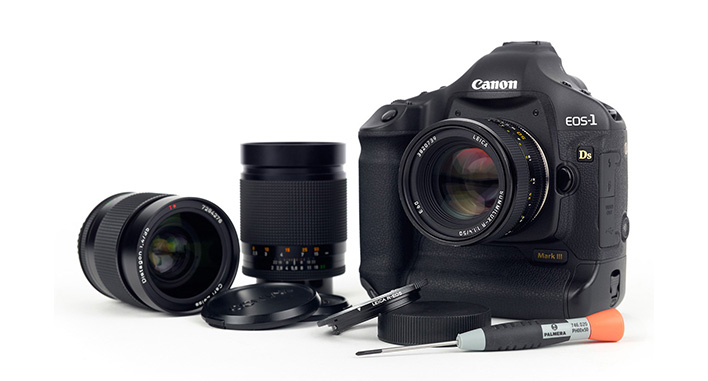
LEICA LENSES THAT FIT CANON DSLR’S
ARCHIVED January 1, 2011
THE FF, 5D, 1.3x AND 1.6x COLUMN HEADINGS
The Leica-R / Canon database is a quick reference to see which Leica-R lenses can be mounted on Canon EF-mount dSLRs via adapter. Most lenses work without issue; however, some have mirror clearance issues. Scrolling to the right provides more information about the lenses.
- FF refers to Canon’s professional full-frame dSLRs such as the Canon Mark III and 1Dx.
- 5D refers to the Canon 5D, Mark II, Mark III and Canon 6D.
- 1.3x refers to the Canon APS-H bodies such as the Canon 1D Mark III and 1D Mark VI.
- 1.6x refers to the APS-C bodies such as the Digital Rebels and Canon 7D.
Y, N, I, M, R, S AND ? DEFINITIONS
- Y means “YES”. The Leica R lens will work and most people have not experienced issues.
- N means “NO”. There is not a realistic solution.
- I means “Iffy”. Conflicting reports of "yes" and "no".
- M means “Mirror Shave”. The lens in question will work if the Canon mirror is shaved. With so many mirrorless camera options now, shaving a mirror is a needless risk in my opinion.
- S means “Shroud”. Some Leica lens have a protective shroud covering portions of the rear mount. The lens in question will fit if the rear plastic shroud is removed. Scroll down for more info on lens shrouds.
- R means “O-Ring”. Currently this only refers to the Leica 50mm F1.4 Summilux-R (E60). There is rubber ring protecting the rear element - similar to a rubber band. It is very easy to remove and re-install.
- ? means no data available.
Canon 5D and 5D Mark II owners have reported various mirror clearance issues. Complicating matters, there are variances amongst Canon 5D’s. Thus, the Canon 5D earned its own column. Whereas Canon EF-s cameras have smaller mirrors, so just about any lens will work them. The Canon 1-Series (1D, 1D II, etc.) usually work out fine. According to marketing literature the Canon 1D Mark III sports a larger viewfinder. User feedback indicates it is best to consider the 1D Mark III as having the same clearance as a 1Ds and 1Ds Mark II.
THE DATABASE SHOWS “YES”, BUT I KNOW THE LENS DOESN’T FIT!!!
Deciding whether a lens deserves a “YES” or not can be tricky because one reader may report “Yes” and another person says it will not work. Most likely the problem is not the lens or the camera body, but the adapter. To address these conflicting reports the “I” category was added, meaning “iffy” - as in the lens may or may not work.
The flange thickness on a Canon / Leica-R adapter is ~3mm, thus Leica R lenses generally adapt with fewer issues than Contax lenses. However, there are some exceptions. Before modifying on a Leica R lens in any non-reversible fashion (and diminishing its market value), please consider using the lens on a mirrorless camera instead.
- Leica 21-35mm F3.5 ASPH Vario-Elmarit-R
Applies to the Canon 1Ds Family, Canon 1D Family and 5D Family
The Leica 21-35mm ASPH is a simple solution. The plastic shroud at the rear of the lens interferes with the Canon mirror. Three small jewelers screws hold the plastic shroud in place - unscrew them, remove the shroud, put the screws back in place for safe keeping. The entire process takes less than a minute with the proper screw driver and is 100% reversible. I owned the 21-35mm ASPH and it worked with the Canon 1Ds and 1Ds Mark II. The Canon 5D may still have issues in the 21 to 24mm range, so its value is “I” (iffy).
- Leica 28-90mm F2.8-4.5 ASPH Vario-Elmarit-R
Applies to the Canon 1Ds Family, Canon 1D Family and 5D Family
The 28-90mm has a similar looking shroud as the 21-35mm; however, there is a small spring held in place by the shroud. Removing the shroud releases the spring which can lead to problems. We have received conflicting reports with one person successfully removing the shroud without losing the spring. Another person said he removed the shroud and the spring popped out and the lens had to go to Leica for repair. Before 2012 the 28-90mm was pretty much a non-starter, but now Leitax offers a conversion kit - see the Leitax site for more info.
- Leica 16mm F2.8 Fisheye
Applies to the Canon 1Ds Family, Canon 1D Family and 5D Family
Unfortunately a mirror shave is required if infinity focus is required. However, if willing to use the lens focused at closer distances such as 5 feet, it can be usable. The 16mm fisheye’s rating is “I”.
- Leica 19mm F2.8 Elmarit-R
Applies to the Canon 1Ds Family, Canon 1D Family and 5D Family
The second version Leica 19mm F2.8 Elmarit-R requires extreme “surgery”. In terms of optical performance, the second version is the one you want - and it costs much more than the original 19mm. The original 19mm is probably a good lens for the 19mm look, but if seeking sharp corners, the second version is a better choice. Some owners modified the 19mm Elmarit’s (second version) rear housing by grinding it down approximately 2mm. Not the entire rear housing has to be ground, just lower half which catches the mirror as the mirror swings up. The earlier 19mm F2.8 Elmarit fits the Canon bodies without modification.
- Leica 24mm Elmarit-R
Applies to the Canon 1Ds Family, Canon 1D Family and 5D Family
The Leica 24mm Elmarit-R does not clear the mirror and a lens modification is not possible. If you are willing to shave the mirror on your 1Ds or 5D, then maybe. Some options include the Canon 7D or other Canon EF-s dSLR. The EF-s bodies have smaller mirrors, so there are no clearance problems. An alternative to the 24mm Elmarit-R is the 28mm F2.8 Elmarit-R which receives very favorable reviews.
- Leica 28mm F2.8 Elmarit R - Model 11259 and Model 11333
Applies to the Canon 5D Family
These two lenses are marked “I” (iffy) because of conflicting reports with the Canon 5D Mark II. Optically the lenses are identical, model #11333 is simply the ROM version. There have been mixed results with #11333 on the Canon 5D (and Mark II), so it was already coded as “I”. Subsequently, another person reported their 28mm Elmarit (#11259) fit fine on the Canon 5D Mark II. Even though he had success, I still coded the lens as an “I” because it is the same mount, etc. as model 11333. So, the 28mm Elmarit may work on a Canon 5D / 5D Mark II; however, some people may encounter clearance issues due to adapter thickness and/or production variances the mirror box.
- Leica 35mm Summilux
Applies to the Canon 1Ds Family, Canon 1D Family and 5D Family
The 35mm Summilux-R will not clear the mirror on Canon full-frame bodies. If you are willing to shave the mirror on your 1Ds or 5D, then maybe. Some options include the Canon 7D or other Canon EF-s dSLR. The EF-s bodies have smaller mirrors, so there are no clearance problems. The simple solutions are to use a Sony A7rII or with Zeiss 35mm F1.4 Distagon ZE.
- Leica 35-70mm F2.8 F2.8 ASPH Vario-Elmar R
Applies to the Canon 1Ds Family, Canon 1D Family and 5D Family
Like the Leica 21-35mm F2.8 ASPH Vario-Elmar R, the plastic shroud at the rear of the lens may interfere with the Canon 1Ds (Mark I, Mark II and Mark III) mirror. Three small jewelers screws hold the plastic shroud in place - unscrew them, remove the shroud, put the screws back in place for safe keeping. The entire process takes less than a minute with the proper screw driver and is 100% reversible. The shroud is a cosmetic piece, removing it has no effect on the lens’ operation or performance. This solution may work for the Canon 5D and 5D Mark II; however, there have been no user reports to verify whether or not this solution will work.
- Leica 50mm Summilux-R E60 (Last / Current Version)
Applies to the Canon 1Ds Family, Canon 1D Family and 5D Family
With a minor modification the last version of the 50mm Summilux-R (Model #11344, E60 filter and sliding hood) will work on Canon FF dSLRs. There is a rubber ring protecting the rear element. This ring needs to be removed (it is similar to a fancy rubber band) and the mirror will clear.
DOES ROM OR CAM MATTER?
When fitting a Leica lens on a Canon EF mount the CAM vs ROM option does not matter since the Leica ROM contacts do not work with a Canon body. With most lenses being purchased in the secondhand market, the biggest upside of a ROM lens is that it is most likely newer and maybe in better condition than an older lens.
WHAT DOES “R-CAM” MEAN?
Some lenses are R-CAM only, R-CAM means the lens will only work on R-bodies, not the older Leicaflex bodies. Many CAM lenses could be upgraded to ROM by Leica, so just because a lens has a Leica ROM, do not assume it is the newer model.
LEICA-R / CANON EF ADAPTERS
My preferred adapter is Leitax because they are actually screwed to the Leica R lens, providing a very secure connection with no play or wobble. For more info on Leitax adapters, check out my review. Novoflex also makes very good adapters.
DISCLAIMERS
If you decide to mount a non-Canon lens to a Canon camera, you are doing so at your own risk. If something feels wrong --- stop and examine the adapter, the lens, etc. Using a Canon EOS / Contax adapter is usually trouble-free; however, there are exceptions. Until you know for sure a given lens and adapter combination works correctly with your camera, go slow and pay close attention.
As of 2011 the database is no longer updated. And with mirrorless cameras like the Sony A7rIV, adapting lenses (to the Sony) is problem-free.


